Cool belt
Maine yard facts: grass, season and the rules that apply
Maine lawns are cool-season grass that grows fastest in spring and fall. Here is how that shapes the mowing and feeding calendar, and who regulates the work.
By LawnElm Editorial Team Updated 6 min read
- Grass belt
- Cool-season
- Common grasses
- Bluegrass, fescues
- Fertilizer law
- Retail phosphorus signs
Short version
University of Maine Cooperative Extension calls Maine a near-perfect climate for cool-season lawn grasses and lists Kentucky bluegrass, red fescue, tall fescue and perennial ryegrass. Extension advises one fertilizing around Labor Day, none before spring green-up or after September 15, and phosphorus-free fertilizer unless a soil test says otherwise. The Board of Pesticides Control requires a commercial license to apply pesticides for pay, and Dig Safe asks for three business days' notice.
Maine at a glance
Grass and climate
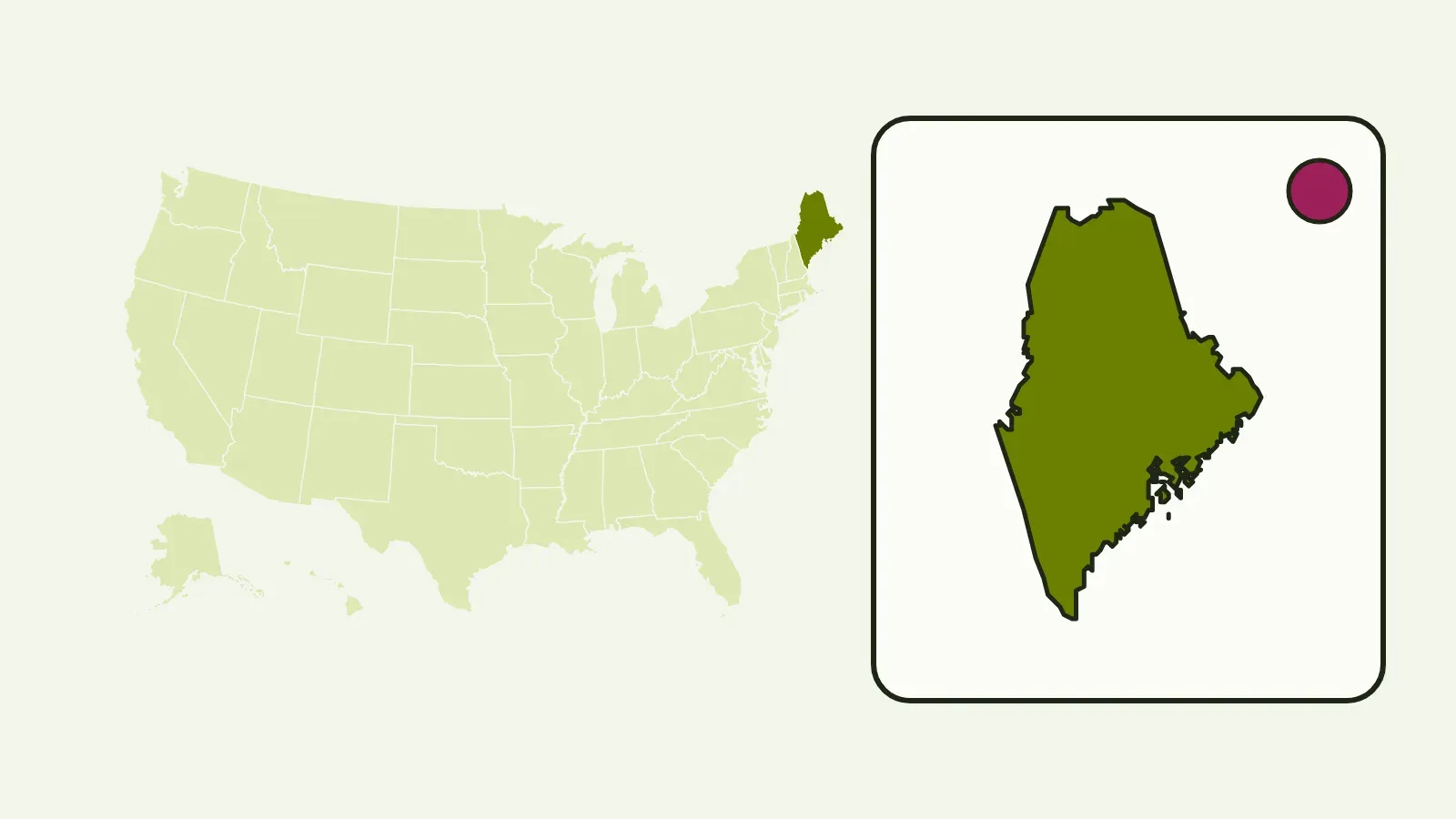
University of Maine Cooperative Extension says Maine provides a near-perfect climate for cool-season lawn grasses, which is why Maine sits in the cool belt on the state map. Its home lawn bulletin lists four grasses suited to Maine lawns: Kentucky bluegrass, red fescue, tall fescue and perennial ryegrass. It adds that many types of perennial ryegrass are not hardy in Maine.
Cool-season grasses grow fastest in cool, moist weather. UMaine says lawns need more frequent mowing in spring and fall, when they grow rapidly, than in hot, dry midsummer, when they grow slowly or even go dormant. The jobs on your yard calendar follow that cycle.
- Kentucky bluegrass has excellent tolerance of low winter temperatures and poor shade tolerance, according to UMaine's grass table.
- Red fescue is shade tolerant, grows on dry and acid soils, and is used in mixtures with bluegrass.
- Tall fescue has a high tolerance of summer heat and wear, and UMaine says it is often used on slopes and banks.
Mowing and feeding
UMaine says mowing height depends on the grass, the weather, the stage of growth and how much upkeep you want. Bunch-type grasses such as tall fescue and perennial ryegrass must be cut to 3 inches or more, and a lawn that mixes grass types should be cut high to suit them. For most home lawns, UMaine advises the high end of the height range for the grass. Its fertilizing bulletin says to mow as high as possible, leaving at least 3 inches, and to leave the clippings on the lawn.
UMaine also gives the one-third rule: remove no more than a third of the leaf height in one mowing. Its example is a Kentucky bluegrass lawn kept at 3 inches, which is mowed when the grass reaches 4 to 4.5 inches. A newly seeded lawn is first mowed at 4 inches. See lawn mowing for how the rule sets your schedule.
Feeding is where Maine advice is most specific. UMaine says a healthy lawn may need no fertilizer, and that a soil test shows what is lacking. If you do fertilize, it gives these guidelines:
- Use a phosphorus-free fertilizer, with a 0 as the middle number on the bag, unless a soil test says the lawn needs phosphorus.
- Apply no more than 2 pounds of nitrogen per 1,000 square feet of lawn per year on an older lawn.
- If you feed once a year, apply 1 pound or less of nitrogen per 1,000 square feet between August 15 and September 15.
- If you split the feeding, put the other half in May, after spring green-up.
- Do not fertilize before spring green-up or after September 15, and leave a strip of at least 25 feet unfertilized next to water.
UMaine says a lawn mowed with a mulching mower can use a third to a half less than the recommended annual rate. The fertilizing bulletin is dated 2011, so treat its details as a starting point and confirm them with your county extension office. The lawn supplies tool turns a label rate into bags.
Rules for fertilizer and spraying
Maine's fertilizer law is about sales, not use. Under 38 MRSA section 419, a store that sells fertilizer containing phosphorus must post a Department of Environmental Protection-approved sign saying the product is not appropriate for non-agricultural lawns or turf, unless a lab soil test shows phosphorus is needed or the fertilizer is for a new lawn, reseeding or overseeding. The statute defines a fertilizer containing phosphorus as one with more than 0.67 percent phosphate by weight. The sources listed below do not set a statewide blackout period or application limit for homeowners or crews.
The Board of Pesticides Control says a commercial license is required to use any pesticide as a paid service, and it names lawn care and tree and shrub care as examples. A licensed operator works under a licensed master applicator, and the license is tied to the company. Applicators must pass a core exam and at least one category exam. Categories 3A (outdoor ornamentals) and 3B (turf) cover most yard work. Custom applicator companies, other than a sole proprietor with no employees, need a firm license, and the Board requires proof of liability insurance.
The sources listed below do not describe a separate state license for a mowing or landscaping crew. Mowing and basic yard work are not the same as spraying, so ask any company that offers weed or grub treatments for its license and the category it covers.
- The company's firm license, or the sole proprietor's own commercial license
- The applicator's license category, such as 3A or 3B
- The product name and the rate, in writing
Call 811 and local rules
The Maine Public Utilities Commission says Maine law requires anyone using power tools to penetrate the ground, homeowners included, to mark the dig area in white, call 811 three business days (72 hours) before digging, and notify any non-member owners of underground lines. Dig Safe passes your call to its member utilities. The commission says it can fine up to $10,000 per violation. The steps are in call 811 before you dig.
Towns, water districts and homeowners' associations can add rules for grass height, watering and yard work. No particular town's ordinance is covered here, so read yours or ask the town office. The guide to HOA and city yard rules lists what to look for.
Hiring a crew in Maine
Ask for the license number and category before anyone sprays, and get the product and the rate in writing. If a crew offers to fertilize, ask for the analysis on the bag and the rate in pounds of nitrogen per 1,000 square feet, so you can check it against UMaine's limits. The guide to hiring a lawn crew lists what a written quote should say.
Questions people ask
What kind of grass do most Maine lawns have?
Cool-season grasses. UMaine Extension lists Kentucky bluegrass, red fescue, tall fescue and perennial ryegrass as suited to Maine lawns, and calls the state's climate near-perfect for cool-season lawn grasses.
When should I fertilize a Maine lawn?
UMaine says to apply no fertilizer before spring green-up or after September 15. If you feed once a year, do it between August 15 and September 15. If you split it, put the other half in May, after green-up.
Can I buy fertilizer with phosphorus in Maine?
Yes, but a store that sells it must post a Department of Environmental Protection-approved sign saying it is not appropriate for non-agricultural lawns, unless the buyer has a soil test showing a need or is seeding a new lawn. UMaine advises phosphorus-free fertilizer for established lawns.
Does a lawn crew need a license to spray in Maine?
Yes. The Board of Pesticides Control says a commercial license is required to use any pesticide as a paid service, including lawn care.
How much notice does Dig Safe need?
The Maine Public Utilities Commission says to call 811 three business days (72 hours) before digging.
Sources
- Bulletin 2243, Maintaining a Home Lawn in Maine (University of Maine Cooperative Extension)
- Bulletin 2154, Fertilizing a Home Lawn in Maine (University of Maine Cooperative Extension)
- Use Phosphorus-Free Fertilizer to Keep Lawns Green, Waters Clean (Maine Department of Environmental Protection)
- Title 38, section 419 (Maine Revised Statutes)
- Commercial Applicators (Maine Board of Pesticides Control)
- Damage Prevention (Maine Public Utilities Commission)
Checked on November 20, 2026. Licensing rules and local ordinances change; confirm with the Maine Board of Pesticides Control, your county extension office and your town before you hire or spray.
Next in the yard
-

Yard job
Lawn mowing
How tall to mow, how often, and what a weekly visit includes.
-

Yard job
Lawn fertilizing
When to feed cool- and warm-season lawns, how to size a feeding, and what rules apply.
-

Guide
Call 811 before you dig
How the free 811 locate works, why notice periods differ by state, and who calls when a crew digs.