Transition belt
Maryland yard facts: grass, season and the rules that apply
Most Maryland lawns are tall fescue or zoysia, and the state has a lawn fertilizer law with a winter blackout. Here is how that shapes the jobs, and who regulates the work.
By LawnElm Editorial Team Updated 7 min read
- Grass belt
- Transition
- Common grasses
- Tall fescue, zoysia
- Fertilizer law
- Blackout Nov 16 to Mar 1
Short version
University of Maryland Extension says that for most Maryland lawns the dominant grass is either tall fescue, a cool-season grass, or zoysia, a warm-season grass. The Maryland Department of Agriculture says everyone must follow the state's lawn fertilizer rules, including a ban on applying lawn fertilizer between November 16 and March 1, and it licenses businesses that do pest control work.
Maryland at a glance
Grass and climate
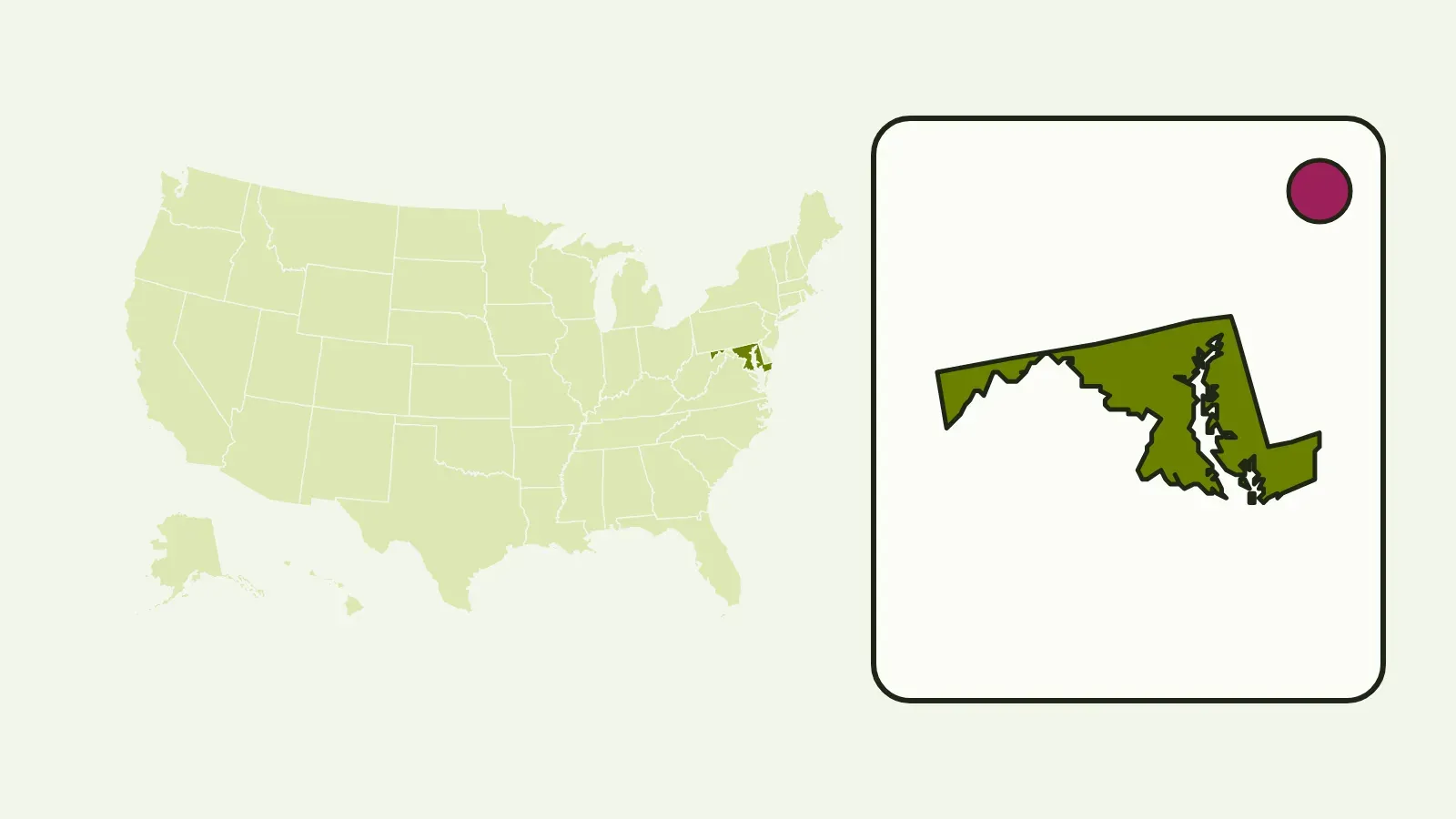
University of Maryland Extension says the right care depends on whether the grass is cool-season or warm-season, and that for most Maryland lawns the dominant grass is either tall fescue or zoysia. For a lawn that mixes grasses, it says to base the care on whichever grass dominates. Because both kinds are common, Maryland sits in the transition belt on the state map.
The two grasses keep different calendars. UMD says tall fescue goes dormant in hot, dry weather, when it is normal for it to turn brown, and greens up again when cooler temperatures and rain return. It names late summer into early autumn as the prime season for starting a tall fescue lawn. Zoysia is generally dormant from mid-October to mid-May in Maryland, and its prime planting season is late spring into early summer. The jobs on your yard calendar follow the grass, not the date.
- Tall fescue and Kentucky bluegrass are cool-season grasses, and the Maryland Department of Agriculture (MDA) says to feed them in fall.
- Fine fescue is not mown often and, UMD says, grows best with less nitrogen than tall fescue.
- Zoysia and bermudagrass are warm-season grasses, and MDA says to feed them in late spring or summer.
Mowing and feeding
MDA gives mowing heights for each grass and the one-third rule: remove no more than a third of the grass height each time you mow. It says mowing at the proper height can cut weed problems by as much as 80 percent. See lawn mowing for how the rule sets your schedule.
| Grass | Mowing height |
|---|---|
| Tall fescue | 3 to 4 inches |
| Fine fescue | 3 to 4 inches |
| Kentucky bluegrass | 2.5 to 3.5 inches |
| Zoysia | 1.5 to 2.5 inches |
| Bermudagrass | 1 to 1.5 inches |
UMD's lawn calendar for tall fescue puts the main feeding in late summer to mid-autumn, from mid-August to mid-October, based on a soil test. It limits spring feeding to April into about mid-May, and only for lawns that are weak, sparse or heavily used, or that have a history of crabgrass or red thread disease. It says not to fertilize in summer. For zoysia, it says to feed once the lawn greens up from dormancy, to make any second application no later than mid-August, and to skip fertilizer in autumn.
UMD says to sow seed or lay sod for a tall fescue lawn no later than mid-October, because seed takes about two weeks to germinate and killing frosts can come in November. It also says to remove thick layers of fallen leaves or shred them in place with the mower. The lawn supplies tool turns a label rate into bags.
Fertilizer and pesticide rules
MDA says everyone must obey the state's fertilizer application restrictions, use best management practices, observe the blackout dates and follow University of Maryland recommendations. For a homeowner, MDA lists these rules:
- A single application may not exceed 0.9 pound of total nitrogen per 1,000 square feet, with no more than 0.7 pound of that soluble.
- Phosphorus may only be applied when a soil test shows it is needed, or when a lawn is being established, patched or renovated.
- Do not apply lawn fertilizer between November 16 and March 1, or when the ground is frozen or heavy rain is predicted.
- Keep fertilizer 10 to 15 feet from waterways, and do not use fertilizer to de-ice walkways or driveways.
If you hire a lawn service, MDA says to confirm that its professionals are certified and licensed by MDA, and it keeps a directory of for-hire professional fertilizer applicators. A lawn crew that feeds your grass is covered by the same limits as you are.
For spraying, the state's Pesticide Applicator's Law and COMAR 15.05.01 apply. The Maryland OneStop licensing portal says MDA issues a pesticide business license to any business that performs pest control work, and that each place of business is licensed in the categories where it operates. The business must designate an individual certified in those categories and carry liability insurance. MDA's category list includes Turf, for weed, insect or disease control on lawns, and Ornamental Exterior, for pests on landscape plants and weeds in plant beds.
UMD adds a local rule: it says there are lawn pesticide restrictions in Montgomery County, and it advises verifying that local regulations permit a product before you use it. The sources listed below do not describe a separate state license for a mowing or landscaping crew, or for tree work, so ask any company for its licenses before it does more than mow.
Call 811 and local rules
Miss Utility of Maryland says it is the approved one-call notification center for the Western Shore of Maryland and the District of Columbia, under the Miss Utility name, and for the Eastern Shore of Maryland and Delaware, as Delmarva 811. Call 811 before you dig a post hole, plant a tree or build a deck. The notice period is not stated on the pages listed below, so ask the center how many working days it needs. The steps are in call 811 before you dig.
Counties, cities and homeowners' associations can add rules for grass height, watering and yard work, and MDA notes that watering may be prohibited during a drought. No particular ordinance is covered here, so read yours or ask the local office. The guide to HOA and city yard rules lists what to look for.
Hiring a crew in Maryland
Ask for the pesticide business license number and the certified applicator's category before anyone sprays, and ask for the fertilizer rate in pounds of nitrogen per 1,000 square feet so you can check it against MDA's single application limit. Get the product and the rate in writing. The guide to hiring a lawn crew lists what a written quote should say.
Questions people ask
What kind of grass do most Maryland lawns have?
UMD Extension says most Maryland lawns are either tall fescue, a cool-season grass, or zoysia, a warm-season grass.
When is lawn fertilizer not allowed in Maryland?
MDA says not to apply lawn fertilizer between November 16 and March 1, and not when the ground is frozen or heavy rain is predicted.
How much fertilizer can go on a Maryland lawn at once?
MDA says a single application may not exceed 0.9 pound of total nitrogen per 1,000 square feet, and no more than 0.7 pound of that can be soluble nitrogen.
Does a lawn crew need a license to spray in Maryland?
MDA licenses businesses that perform pest control work, and the business must designate an individual certified in the categories it works in. Turf covers weed, insect and disease control on lawns.
Sources
- Lawn Maintenance Calendar (University of Maryland Extension)
- Lawn Fertilizer Guide for Homeowners and Residents (Maryland Department of Agriculture)
- Pest Control Categories (Maryland Department of Agriculture)
- Pesticide Business License (Maryland OneStop)
- Miss Utility of Maryland
Checked on November 20, 2026. Licensing rules and local ordinances change; confirm with the Maryland Department of Agriculture, your county extension office and your county or city before you hire or spray.
Next in the yard
-

Yard job
Lawn mowing
How tall to mow, how often, and what a weekly visit includes.
-

Yard job
Lawn fertilizing
When to feed cool- and warm-season lawns, how to size a feeding, and what rules apply.
-

Guide
How to hire a lawn crew
Licenses, insurance and written quotes to check before a lawn or landscape crew starts work.