Transition belt
Missouri yard facts: grass, season and the rules that apply
MU Extension's Missouri lawn calendar is written for cool-season grasses, with mowing from April and the big feeding in September. Here is how that shapes the jobs, and who regulates the work.
By LawnElm Editorial Team Updated 6 min read
- Grass belt
- Transition
- Common grasses
- Tall fescue, bluegrass
- Spray for hire
- License required
Short version
MU Extension's Missouri lawn calendar is built around cool-season grasses: tall fescue, Kentucky bluegrass, perennial ryegrass and fine fescue. It starts mowing in April, runs it until growth stops in the fall, and calls September the most important month to fertilize. The Missouri Department of Agriculture licenses anyone who applies pesticides to another person's land for a fee, and Missouri law asks an excavator to give notice at least two working days before digging.
Missouri at a glance
Grass and climate
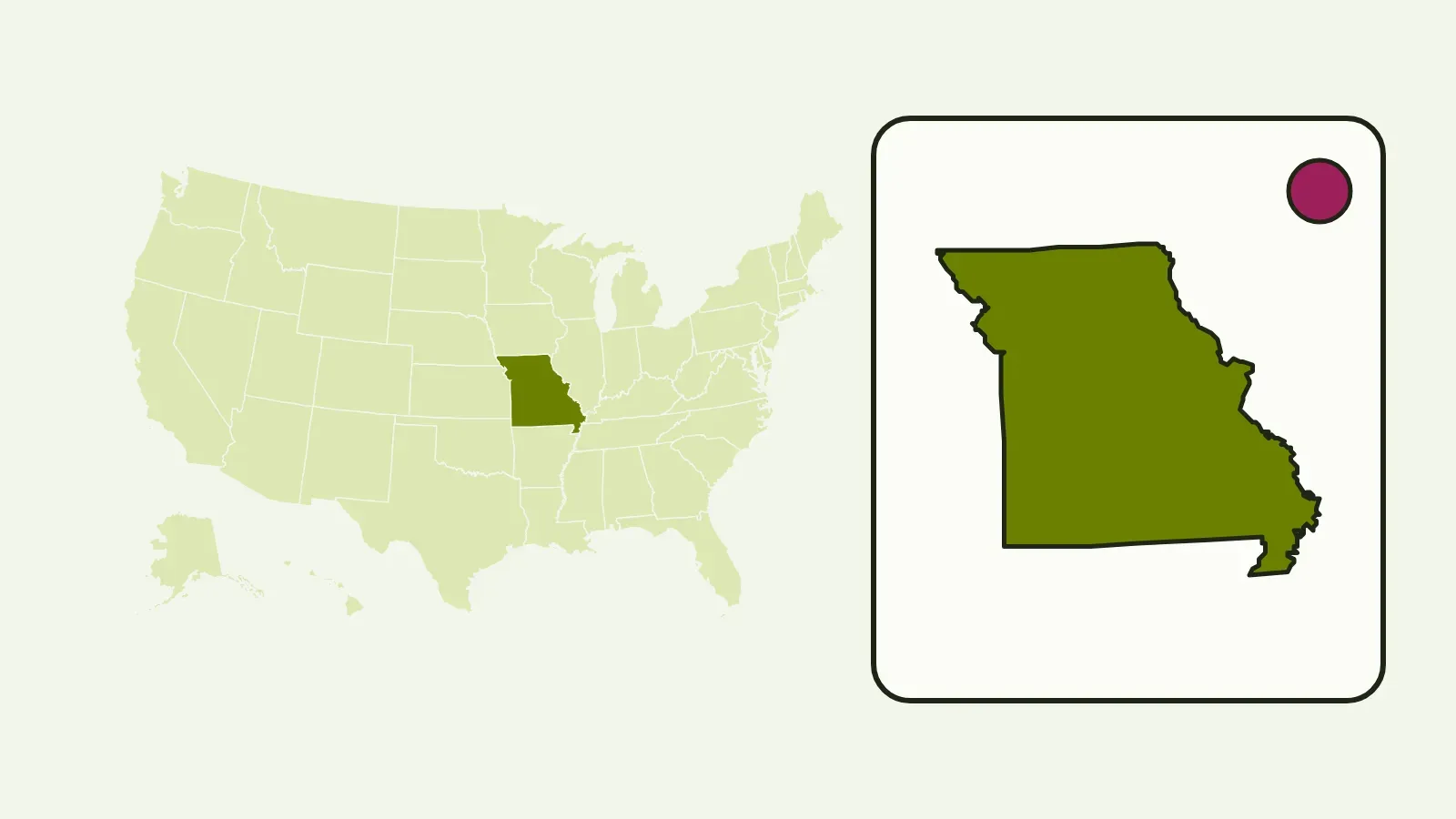
The University of Missouri Extension's lawn maintenance calendar, revised in April 2025, is written for cool-season grasses: Kentucky bluegrass, perennial ryegrass, tall fescue and fine fescue. It says its timing is approximate for central Missouri and may vary by two weeks or more depending on the region of the state and the year's weather. On the state map this site files Missouri in the transition belt, the band where neither kind of grass thrives year-round. That placement is the site's default, not a finding from the MU publication.
MU describes how cool-season grasses handle a Missouri summer. They protect themselves by going semidormant in high heat or drought. They stop growing and turn brown, then bounce back with enough water and cooler weather, usually in September. Tall fescue stays green longer into the summer than other nonirrigated cool-season grasses because of its deep root system.
- Tall fescue has the highest mowing range in MU's table and the longest summer color.
- Kentucky bluegrass spreads by underground stems called rhizomes and thickens again when water returns after summer dormancy.
- Perennial ryegrass and fine fescues should not be grown alone without irrigation in Missouri, MU says, because they bunch under moisture stress. MU says annual ryegrass is not a suitable lawn grass in the state.
Mowing and feeding
MU's calendar says to start mowing as needed in April, at the recommended heights, and to keep mowing at regular heights through October and November until growth stops. It repeats the standard guide: never remove more than one-third of the green leaf area in one mowing. See lawn mowing for how that sets your schedule.
| Grass | Spring | Summer | Fall |
|---|---|---|---|
| Tall fescue | 2 to 3.5 inches | 3 to 4 inches | 2.5 to 3.5 inches |
| Kentucky bluegrass | 1.5 to 2.5 inches | 2 to 3.5 inches | 1.5 to 2.5 inches |
| Perennial ryegrass | 1.5 to 2.5 inches | 2.5 to 3.5 inches | 1.5 to 2 inches |
MU says summer heights should also be used where the grass grows in shade, and that all heights may be adjusted for climate, how intensively the lawn is managed and how it is used.
On feeding, MU says all lawns should be fertilized at least once a year. If you want only one feeding, September is an excellent time, and its calendar calls September the most important time to fertilize, at 1 to 1.5 pounds of nitrogen per 1,000 square feet. A spring feeding, if you want one, belongs in early to mid-April at 0.5 to 1 pound. MU says not to apply nitrogen past May 1, because it encourages foliar disease. For a year of total nitrogen, its table gives 2 to 3 pounds for common Kentucky bluegrass and 3 to 4 pounds for tall fescue or ryegrass. The lawn supplies tool turns a rate like that into bags, and your fertilizer label and a soil test come first.
For water, MU says a reasonable summer rule is rain plus irrigation that totals 1 inch per week, applied deeply and not in a little sprinkle each day, ideally in the early morning hours.
Who regulates what
The Missouri Department of Agriculture's Pesticide Program licenses pesticide applicators and dealers under the Missouri Pesticide Use Act. New pesticide statutes and rules took effect January 1, 2025, so confirm current requirements with the department. The MU Extension guide to pesticide law, last revised in August 2021, says a certified commercial applicator is authorized to apply pesticides to the lands of another as a service to the public for a fee. That guide names lawn care firms as one of the major businesses that employ commercial applicators, and says a commercial business that uses any pesticide must be licensed, even if it never uses a restricted-use product.
Applicators certify in a category that matches the work. Ornamental and turf pest control is category 3 in the MU guide's table. The guide also describes a licensed pesticide technician, who works under the direct supervision of a certified commercial applicator in ornamental and turf pest control. If a crew sprays your lawn, ask which license it holds and for a copy.
The same guide says fertilizers are not pesticides, so applying fertilizer alone does not need an applicator license, but fertilizer mixed with a pesticide does. That is the 2021 edition, so check the department if a crew sells you a combined product.
Missouri's fertilizer statutes sit in Chapter 266 of the Revised Statutes. Its section titles cover a permit to sell fertilizer, information required on containers, a fertilizer control board and penalties for deficiency. The page this article read lists titles only, so it does not tell you whether the state limits how a homeowner applies fertilizer. Ask the department and your city.
Call 811 and local rules
Missouri's excavation law, Section 319.026 of the Revised Statutes, says an excavator must notify the state notification center at least two working days, and not more than ten working days, before the expected start date. The notice can be made by a toll-free telephone number or on the internet. The law defines a working day as every day except Saturday, Sunday or a legally declared state or federal holiday, and it defines excavation broadly, including digging, grading, trenching, boring and augering. If markings are in place, the law lets you work in the area they cover as long as the markings stay visible. If you cannot start within ten working days, make a relocate request first. See call 811 before you dig for the steps.
Cities, counties, water providers and homeowners' associations can add rules for grass height, watering and yard work. No particular ordinance is covered here, so read yours or ask the local office. The guide to HOA and city yard rules lists what to look for.
Hiring a crew in Missouri
Spraying for hire needs a licensed applicator, so ask any company that offers weed, grub or insect treatments for its license number and for the product and rate in writing. The pages this article read do not say whether Missouri licenses mowing, landscaping or tree work at the state level, so ask your city or county before you assume a crew needs, or does not need, a local license. The guide to hiring a lawn crew lists what a written quote should say.
Questions people ask
What kind of grass do most Missouri lawns have?
MU Extension's lawn calendar covers cool-season grasses: Kentucky bluegrass, perennial ryegrass, tall fescue and fine fescue. It does not say what share of Missouri lawns each grass makes up.
When do I fertilize a Missouri cool-season lawn?
MU Extension says September is the most important time to fertilize, and an excellent time if you feed only once. A spring feeding, if wanted, goes on in early to mid-April, and nitrogen should not go on after May 1.
Does a lawn crew need a license to spray in Missouri?
Yes. MU Extension says a certified commercial applicator is the license for applying pesticides on the lands of another for a fee, and that lawn care firms are among the businesses that need one. The Missouri Department of Agriculture issues it.
How many days ahead do I call before digging in Missouri?
Section 319.026 of the Missouri statutes says at least two working days and not more than ten working days before the excavation starts. Saturdays, Sundays and legal holidays do not count as working days.
Sources
- Cool-Season Grasses, Lawn Maintenance Calendar (MU Extension, G6705)
- Pesticide Laws and Regulations (MU Extension, G855, revised August 2021)
- Pesticide Control (Missouri Department of Agriculture)
- Section 319.026, notice of excavator (Revised Statutes of Missouri)
- Section 319.015, definitions (Revised Statutes of Missouri)
- Chapter 266, Seeds, Fertilizers and Feeds (Revised Statutes of Missouri)
Checked on November 20, 2026. Licensing rules and local ordinances change; confirm with the Missouri Department of Agriculture and your city before you hire or spray.
Next in the yard
-

Yard job
Lawn fertilizing
When to feed cool- and warm-season lawns, how to size a feeding, and what rules apply.
-

Guide
Call 811 before you dig
How the free 811 locate works, why notice periods differ by state, and who calls when a crew digs.
-

Guide
How to hire a lawn crew
Licenses, insurance and written quotes to check before a lawn or landscape crew starts work.