Cool belt
New York yard facts: grass, season and the rules that apply
New York sits in the cool belt, where lawn grass grows hardest in spring and fall. The state also has a lawn fertilizer law that sets dates, distances and a phosphorus limit.
By LawnElm Editorial Team Updated 5 min read
- Grass belt
- Cool-season
- Common grasses
- Bluegrass, fescue, rye
- Fertilizer law
- No feeding Dec 1 to Apr 1
Short version
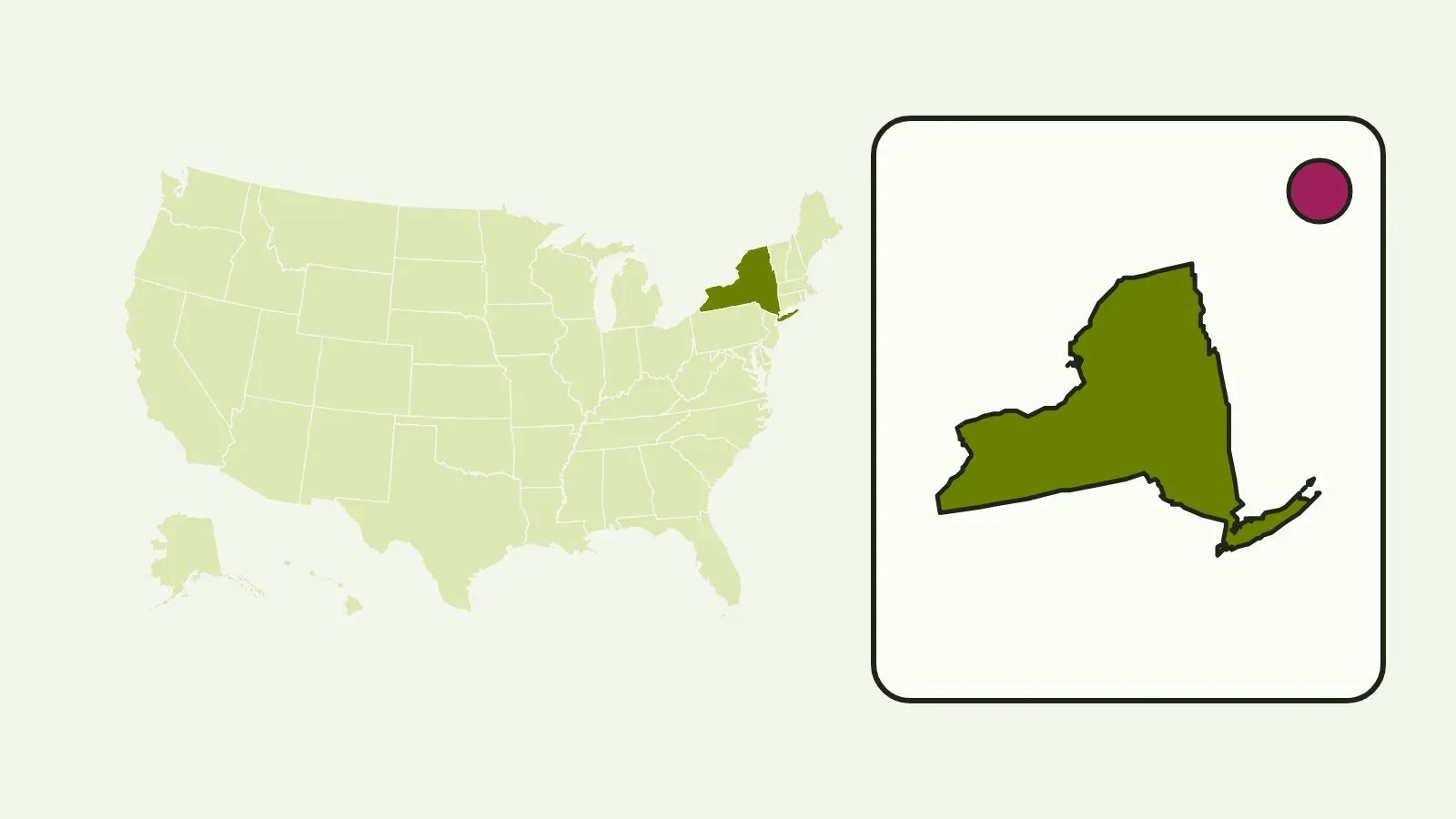
New York is a cool-belt state on the state map, where cool-season grasses such as Kentucky bluegrass, fescues and ryegrass grow most in spring and fall. The strongest rule for a home lawn is the state's lawn fertilizer law, in Environmental Conservation Law section 17-2103. It bars lawn fertilizer from December 1 to April 1, limits phosphorus to lawns with a soil test or a first growing season, and keeps fertilizer away from surface water.
New York at a glance
Grass and climate
New York is in the cool belt on the state map. In that belt, cool-season grasses such as Kentucky bluegrass, fescues and ryegrass dominate, and growth peaks in spring and fall. That is how this site defines the belt, not a New York measurement, so use it as a starting point. Ask your county Cornell Cooperative Extension office which grass has held up on your kind of soil and light before you reseed or sod.
The seasons shape the yard year. Mowing, feeding and watering jobs on the yard calendar follow when the grass is growing, and in New York the state law on lawn fertilizer also puts the winter months off limits for feeding.
Mowing and feeding
Marty Petrovic, a Cornell turf specialist, told the Cornell Chronicle in 2007 that the first step toward a lower-impact lawn is to raise the mower blade to 3 to 4 inches and leave the clippings on the lawn. He said taller grass competes better with weeds and sinks deeper roots, so it better withstands midsummer heat and drought, and needs less watering. That article is an older edition, so treat the numbers as general guidance and check a current Cornell Cooperative Extension publication. See lawn mowing for how the one-third rule sets your schedule.
The same article reports that at least 80 percent of the soil tests sent to the Cornell Nutrient Analysis Laboratory already had enough phosphorus. That is why a soil test comes before any phosphorus fertilizer. The lawn supplies tool turns a label rate into bags once you have one.
The lawn fertilizer law
New York's Nutrient Runoff Law, Environmental Conservation Law section 17-2103, applies to anyone who applies fertilizer to a lawn or authorizes someone else to apply it under a service contract. That includes a crew you hire. The DEC posts the text and calls it a quick reference, not a certified copy, so read the official law before you rely on it.
- Phosphorus. Fertilizer with more than 0.67 percent available phosphate by weight, not counting compost, may go on a lawn only when a soil test shows the lawn needs phosphorus, or during the first growing season of a newly established lawn.
- Winter. No fertilizer on a lawn between December 1 and April 1.
- Paved surfaces. No fertilizer on parking lots, roadways or sidewalks. If it lands there, it must be contained and either put on the lawn legally or placed in a container.
- Water. No fertilizer within 20 feet of surface water. The law makes exceptions for a continuous natural vegetative buffer at least 10 feet wide, and sets a 3-foot minimum when a spreader guard, deflector shield or drop spreader is used. The water rule does not apply to a newly established lawn in its first growing season.
Local governments may set stricter standards than the state. A town that adopted one after January 1, 2011 had to show the DEC that it was needed for local water quality. Ask your town or village whether it has its own fertilizer rule.
Pesticides and licenses
The DEC's Bureau of Pesticides Management runs the state's pesticide programs, and the DEC pesticide pages list a Pesticide Applicator Certification and Business Registration program. The page used for this guide covers aquatic pesticide permits and does not spell out what a lawn-care company must hold. So this page does not name a lawn category. If a crew sprays your lawn, ask what certification and business registration it holds under the DEC program, and ask for a copy.
This page did not confirm a state license for a landscape contractor or tree-care company, so none is described here. Ask your town or village whether it requires one.
Call 811 and local rules
Call 811 before you dig a post hole, plant a tree or build a deck, so utility lines are marked. New York 811 publishes the state's one-call rule, 16 NYCRR Part 753, which says notice must be served at least two but not more than ten working days, not counting the day of the call, before digging starts. Check the current rule with the center before you plan around it. The steps are in call 811 before you dig.
Towns, villages, water systems and homeowners' associations can add rules for grass height, watering and yard work. No particular ordinance is covered here, so read yours or ask the local office. The guide to HOA and city yard rules lists what to look for.
Hiring a crew in New York
Ask any company that feeds or sprays your lawn what product it uses, when, and how much, in writing, and check that the plan keeps within the December-to-April feeding ban and the phosphorus rule. Ask for the certification and registration numbers if it applies pesticides. The guide to hiring a lawn crew lists what a written quote should say.
Questions people ask
Can I fertilize my lawn in winter in New York?
Not between December 1 and April 1. The DEC's text of the Nutrient Runoff Law says no person shall apply fertilizer to a lawn in that period.
Can I use fertilizer with phosphorus on my New York lawn?
Only when a soil test shows the lawn needs it, or in the first growing season of a newly established lawn. The law counts fertilizer above 0.67 percent available phosphate by weight, not counting compost.
How close to a pond or stream can I fertilize?
Not within 20 feet of surface water, except where a continuous natural vegetative buffer at least 10 feet wide separates the lawn from the water. With a spreader guard, deflector shield or drop spreader, the law sets a 3-foot minimum. Check the law text for the full exceptions.
How many days ahead do I call 811 in New York?
New York 811 publishes the state rule, which says notice is served at least two but not more than ten working days before digging, not counting the day of the call. Ask the center to confirm for your project.
Sources
- Text of the Nutrient Runoff Law (NYSDEC)
- Aquatic Pesticide Permits (NYSDEC)
- The Law, 16 NYCRR Part 753 (New York 811)
- For a green lawn, focus on mowing, not early fertilizing (Cornell Chronicle, 2007)
Checked on November 20, 2026. The Cornell article is from 2007 and the New York 811 page is the one-call center's own site. Licensing rules and local ordinances change; confirm with the DEC and your town before you hire or spray.
Next in the yard
-

Yard job
Lawn mowing
How tall to mow, how often, and what a weekly visit includes.
-

Yard job
Lawn fertilizing
When to feed cool- and warm-season lawns, how to size a feeding, and what rules apply.
-

Guide
Call 811 before you dig
How the free 811 locate works, why notice periods differ by state, and who calls when a crew digs.