Transition belt
West Virginia yard facts: grass, season and the rules that apply
West Virginia University Extension writes its lawn advice for cool-season grasses, mowed at about 3 inches and fed in spring, summer and fall. Here is how that fits the jobs and the rules.
By LawnElm Editorial Team Updated 5 min read
- Grass belt
- Transition
- Common grasses
- Bluegrass, fescue, rye
- Spray for hire
- License required
Short version
West Virginia University Extension's lawn pages cover cool-season grasses such as Kentucky bluegrass, tall fescue and perennial ryegrass, and say a mowing height of 3 inches is best kept for them. Its feeding plan runs from March to November. State law requires a pesticide application business license from the Department of Agriculture to spray for hire, and the Department also regulates fertilizer products under the West Virginia Fertilizer Law.
West Virginia at a glance
Grass and climate
West Virginia University Extension's lawn pages are written around cool-season grasses. Its seeding advice names Kentucky bluegrass, tall fescue, perennial ryegrass and thin fescues, and it says a mowing height of 3 inches is best kept for cool-season grasses to promote root development. The same page says most cool- and warm-season turfgrasses can be grown from seed.
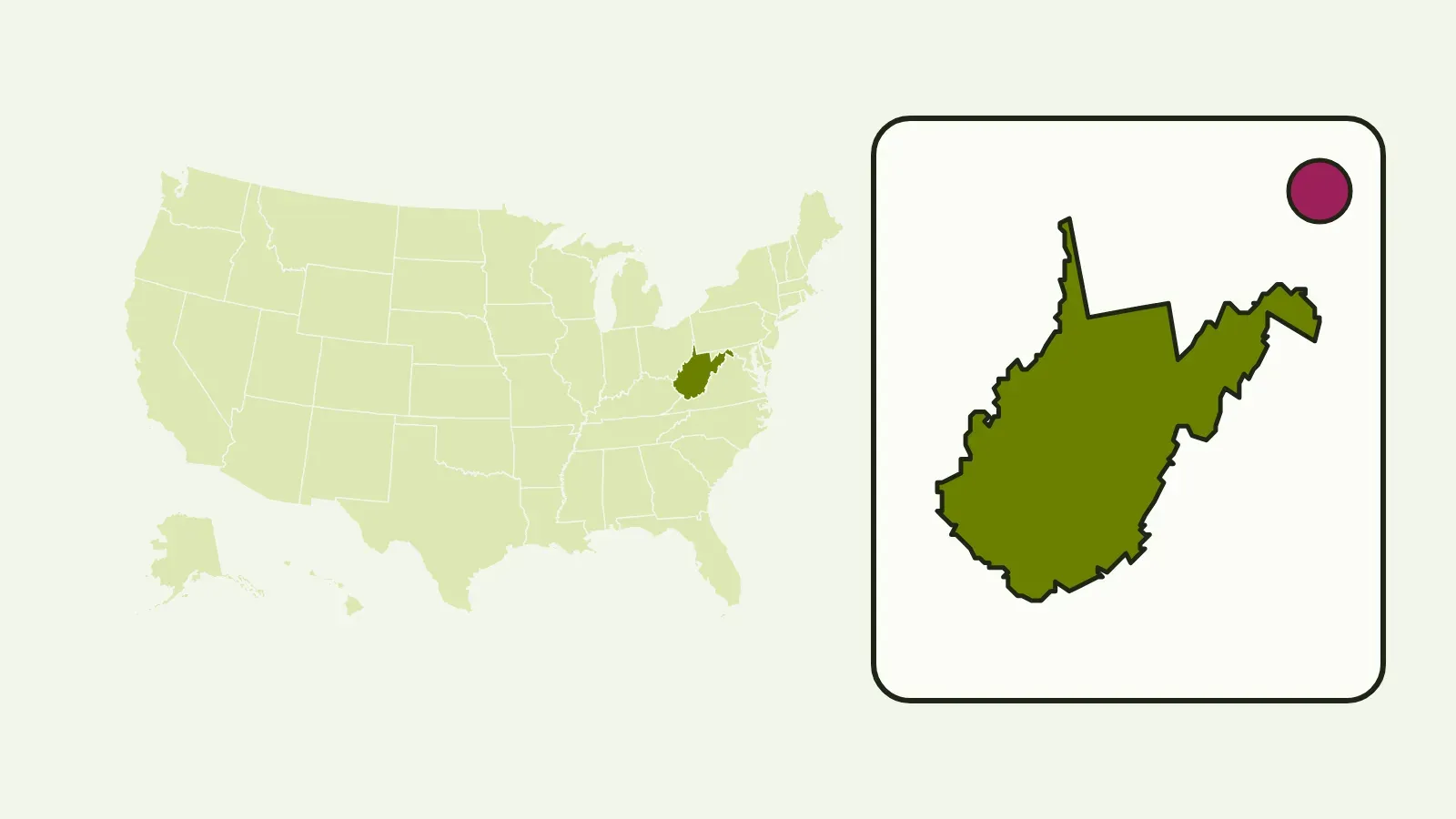
LawnElm's map places West Virginia in the transition belt, where both kinds of grass can be grown with effort and neither thrives year-round. The WVU pages do not draw that belt on a map, so they neither confirm nor change it. If your yard sits in a high valley or on a warm south slope, ask your county WVU Extension office which grass has held up in your area before you reseed or sod. The jobs on your yard calendar follow the grass you actually have.
- Kentucky bluegrass: WVU gives a seeding rate of 1 to 2 pounds per 1,000 square feet.
- Tall fescue and perennial ryegrass: 4 to 8 pounds per 1,000 square feet.
- Thin fescues: 3 to 5 pounds per 1,000 square feet.
Mowing and feeding
For a new lawn, WVU says not to mow young seedlings until they reach 4 inches. Mow them to 3 inches, and mow again when they grow back to 4 inches. After five or six mowings, the height may drop to 2.5 inches for Kentucky bluegrass. A sodded lawn can be mowed to the height you want as soon as there is enough fresh growth. The one-third rule applies to every grass; see lawn mowing for how it works.
For an established lawn, WVU's guideline plan is based on limited nitrogen and moderate growth, so clippings can stay on the lawn. It says to test the soil before fertilizing or liming, and warns that over-feeding can lead to thatch, disease and environmental problems. The rates are pounds of nitrogen per 1,000 square feet.
- Spring, March to April: 0.5 to 1 pound, at green-up, from a complete fertilizer with at least 30 percent slow-release nitrogen.
- Summer, June to July: 0.5 pound, slow-release nitrogen.
- Fall, October to November: 1 to 1.25 pounds, from a complete fertilizer with at least 20 percent slow-release nitrogen, applied before dormancy or about the time of the first frost.
WVU also says a newly seeded lawn will not need more fertilizer for one year. The lawn supplies tool turns a rate like these into bags. The page where WVU gives this plan was last reviewed in May 2017, so check with your county office for the current advice.
Fertilizer and pesticide rules
West Virginia has a state Fertilizer Law, Article 15 of Chapter 19 of the state code. It governs products: it defines fertilizer, includes specialty fertilizer sold mainly for nonfarm use such as lawns, and gives the Commissioner of Agriculture power to inspect and sample products and assess penalties when a product falls short of its guaranteed analysis. The pages read for this guide do not set a limit on how much a homeowner or a crew may put on a lawn, and they do not set blackout dates. Check your city and HOA, and follow the label.
Under the West Virginia Pesticide Control Act, section 19-16A-7, no person may apply pesticides for hire without a pesticide application business license from the Commissioner of Agriculture. The license is annual. The section also says everyone who applies pesticides as a pesticide business must be a certified applicator in the right category or a registered technician working under the direct supervision of a certified commercial applicator. The Department of Agriculture lists commercial applicator, registered technician and licensed pesticide application business among its pesticide programs. The name of the category that covers lawns was not confirmed for this page, so ask the crew which category it holds.
The sources above cover pesticides and fertilizer, not general lawn-care or landscaping business licensing. Ask your city or county what other licenses apply.
Calling 811 and local rules
West Virginia's code has a chapter titled Underground Facilities Damage Prevention, Chapter 24C. This page did not confirm the notice period or how it applies to homeowners, so call 811 before you dig and ask the center for the current rule. See call 811 before you dig.
Cities, counties and homeowners' associations can set rules on mowing, grass height and watering. None were checked for this page, so read your HOA documents and ask your city. The guide to HOA and city yard rules explains where to look.
Hiring a crew in West Virginia
Mowing and raking do not need a pesticide license, but any weed or insect treatment does. Ask for the license or certification number, the product and the rate in writing. The guide to hiring a lawn crew lists what a written quote should say.
Questions people ask
What mowing height does WVU Extension give?
WVU says a mowing height of 3 inches is best kept for cool-season grasses. For a new Kentucky bluegrass lawn, it says the height may drop to 2.5 inches after five or six mowings.
When does WVU Extension say to fertilize a lawn?
Its plan has three feedings: March to April, June to July and October to November. Test the soil first.
Does a lawn spraying company need a license in West Virginia?
Yes. State law says no person may apply pesticides for hire without a pesticide application business license from the Commissioner of Agriculture, and the people who apply must be certified applicators or registered technicians.
Does West Virginia limit phosphorus or nitrogen on lawns?
The state Fertilizer Law pages read for this guide cover fertilizer products, not lawn-use limits. Ask the West Virginia Department of Agriculture and your city before you rely on that.
Sources
- Maintaining a New Lawn (West Virginia University Extension, last reviewed 2017)
- Establishing a Lawn (West Virginia University Extension)
- Pesticides Licenses (West Virginia Department of Agriculture)
- West Virginia Code 19-16A-7, annual pesticide business license (West Virginia Legislature)
- West Virginia Code 19-15-1, Fertilizer Law definitions (West Virginia Legislature)
Checked on November 20, 2026. Licensing rules and local ordinances change; confirm with the West Virginia Department of Agriculture and your city before you hire or spray.
Next in the yard
-

Yard job
Lawn mowing
How tall to mow, how often, and what a weekly visit includes.
-

Yard job
Lawn fertilizing
When to feed cool- and warm-season lawns, how to size a feeding, and what rules apply.
-

Guide
How to hire a lawn crew
Licenses, insurance and written quotes to check before a lawn or landscape crew starts work.